

By Ulemu Mbengwani
It is not every day that we see students transforming classroom knowledge into real-world solutions. At a time when many argue that Malawi’s education system leans heavily on theory with limited practical exposure, one student from the University of Malawi (UNIMA) is challenging that perception.
Fortune Kamphinda, a second-year Bachelor of Science student in Geography, has developed a desktop application designed to detect floods in Malawi, forecast weather conditions, and visually map climate patterns such as rainfall distribution. Driven by a deep passion for technology and how computers work, he hopes his innovation will contribute to disaster preparedness and inspire other students to turn their ideas into meaningful solutions.
“At first, I simply wanted to integrate geographical concepts with technology. But as I continued learning, I realized I could go beyond that and create something that helps people in real-life situations,” he explains.
Kamphinda’s application offers a wide range of capabilities that set it apart as a comprehensive weather and flood monitoring tool. The app generates real-time weather data, including rainfall, temperature, wind speed, cloud cover, atmospheric pressure, and even snowfall.
By analyzing this information, it can detect areas experiencing high rainfall that may lead to flooding, not only across Malawi but also in neighboring regions of Mozambique, Tanzania, and Zambia.
“When a high-risk area is identified, the app alerts users through both audio and text notifications in English and Chichewa. Even when there is no risk, it keeps the user informed,” Kamphinda says.
All weather data is displayed on interactive maps and satellite images, providing a visual understanding of current conditions. One of the app’s most powerful features is its ability to show topography and elevation for any location worldwide.
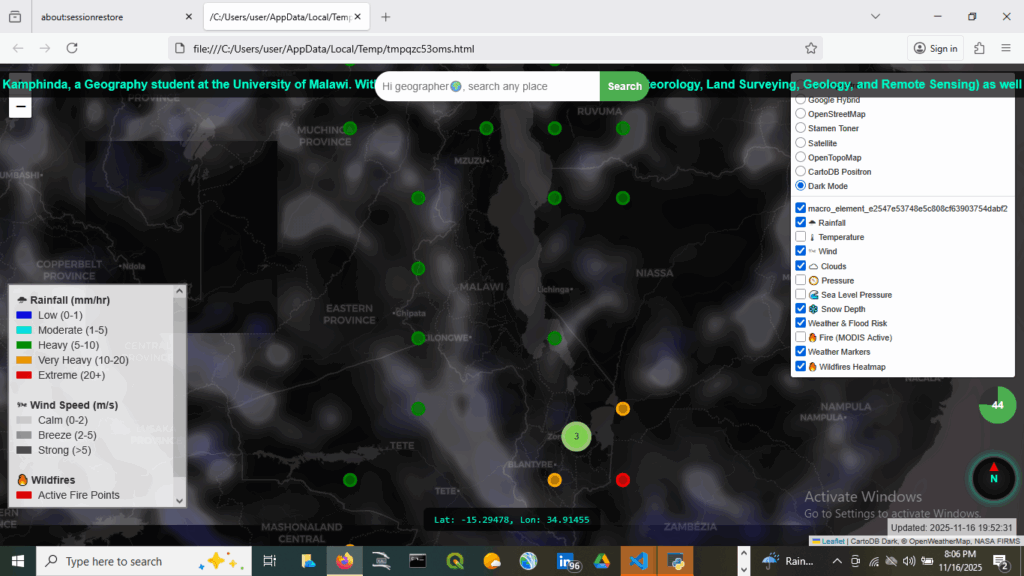
To achieve this, it draws on multiple data sources, including NASA, Google, and ESRI satellites, OpenStreetMap, OpenTopoMap, OpenWeatherMap, and others. The application also leverages technologies such as Folium, Matplotlib, OpenPyXL, Tkinter, and Timedelta, along with programming languages including Python, HTML, Java, and CSS, to process and present the data effectively.
Users can switch to satellite mode to view real images of a place, search for any location globally, and access both current weather information and a five-day forecast based on noon data. The app automatically generates charts to make this data easier to interpret.
“For users who want to track and analyze trends, the app can save current weather data as a log.txt file and five-day forecasts as Excel files for comparison and further analysis,” he adds.
Additionally, the app can track cyclone and hurricane pathways worldwide through integration with advanced platforms like Windy, making it a rich and versatile tool for weather monitoring and disaster preparedness.
Beyond these technical features, Kamphinda highlighted its practical role in supporting local communities, explaining that it is designed to give early warnings before dangerous weather events occur, helping people take timely action to protect lives and property.
Kamphinda sees the app as both a platform for collaboration and a stepping stone for his future career. “I would like to collaborate with the Department of Climate Change and Meteorological Services (DCCMS) and the University of Malawi to improve and expand the project,” he shares.
He also hopes to work in the DCCMS and envisions a time when the department proudly uses software developed by Malawians, including the programs he is creating. The project has strengthened his technical skills and inspired him to pursue opportunities that contribute to national disaster preparedness and climate monitoring.
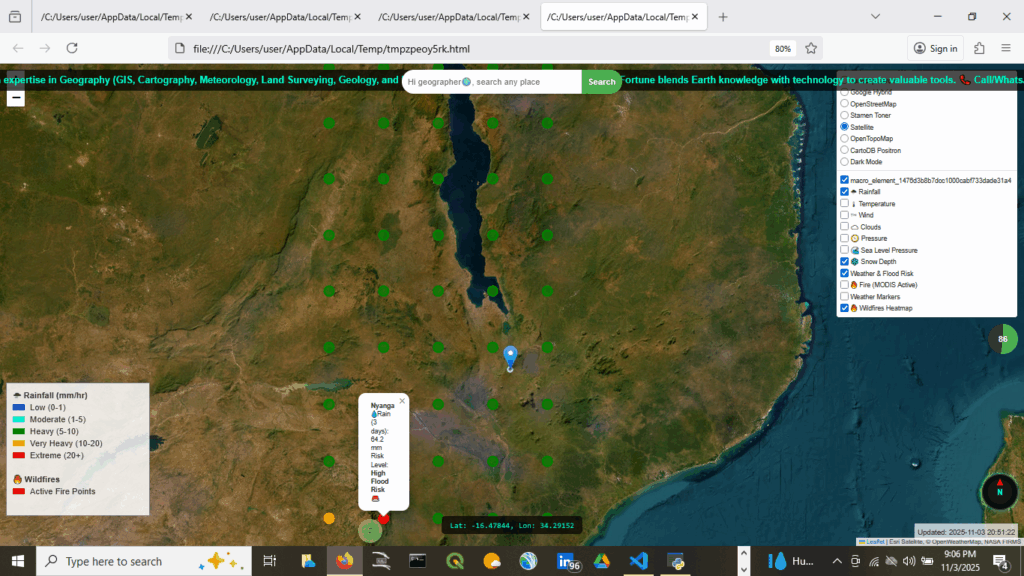
When asked how he managed to achieve this, Kamphinda explains, “Malawian schools encourage us to be curious learners. I used that curiosity to understand how these technologies work. What I learned in first year, especially from Dr. Munthali, was not just theory. It turned out to be practical and very useful.”
Balancing academic work with software development is another challenge he has learned to navigate. “I schedule my time the same way someone practices a skill like football, netball, or music. Consistency is what makes progress possible,” he adds, highlighting the discipline and dedication behind his achievements.
Like any ambitious project, developing the app came with its challenges. Because the application relies on the internet, Kamphinda’s biggest hurdle was purchasing data bundles, especially while working on it during the holiday.
“I explained the project to my father, and he believed in me and supported me financially,” he recalls.
As he continues to develop the app, Kamphinda plans to enhance its accessibility and usefulness by adding features such as suggesting what people should wear based on the forecasted weather, as well as developing a mobile version of the application.
He hopes his journey will inspire other youths to embrace technology and innovation. Kamphinda believes that, when used wisely, technology makes almost anything achievable. By channeling their time, energy, and resources into learning, building, and creating meaningful solutions, young people can turn their ideas into reality and make a tangible impact on their communities.

congrats Brother keep on